





Transform CX with AI at the core of every interaction
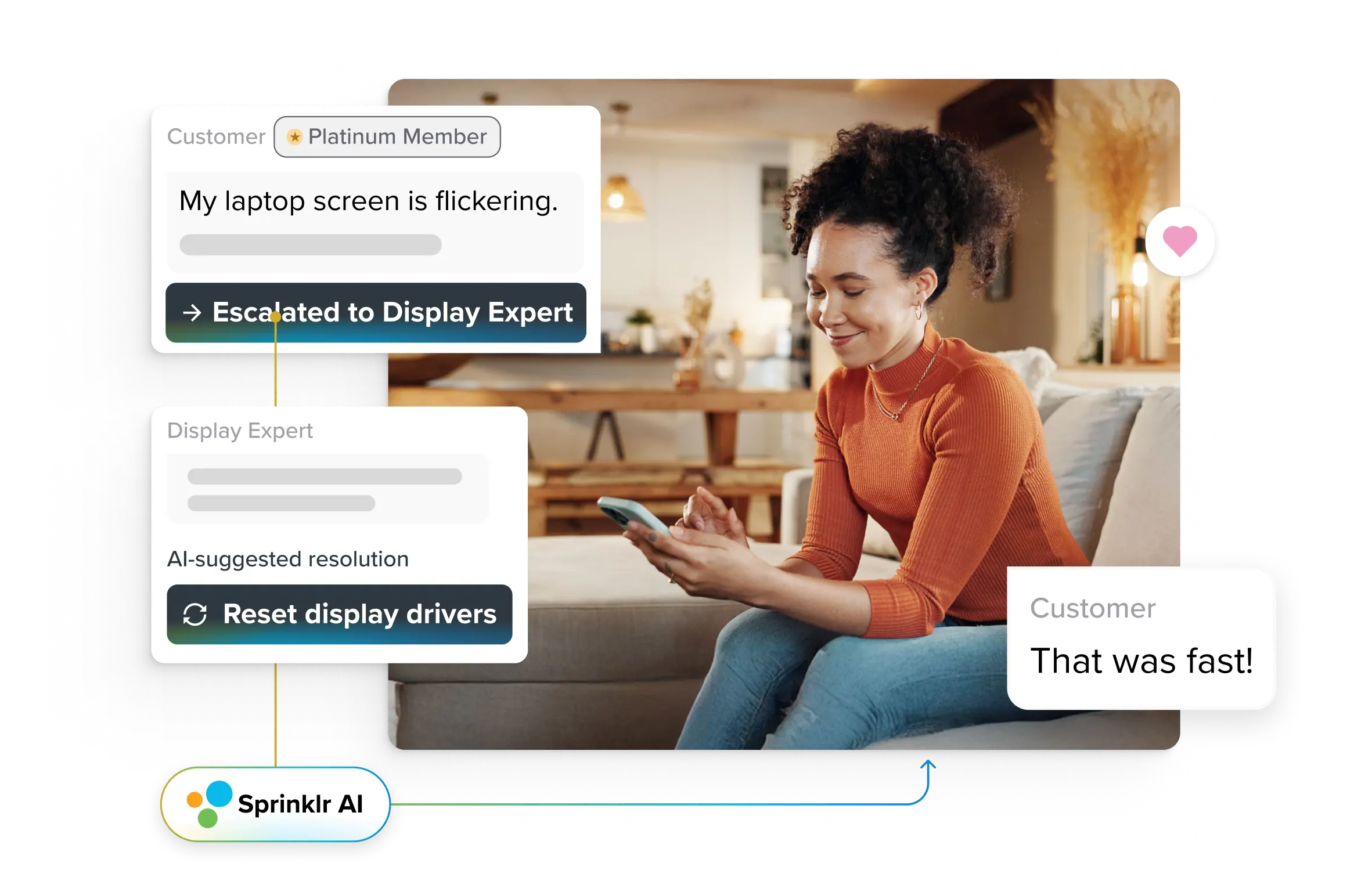
Unify fragmented interactions across 30+ voice, social and digital channels with an AI-native customer experience platform. Deliver consistent, extraordinary brand experiences at scale.




The Best Customer Service Software for 2026

By 2026, customer service software has divided into two categories that share a name.
One kind still sells AI as a chatbot pinned to a shared inbox. The other rebuilds support around AI agents that resolve cases end-to-end, hand the exceptions to a human with full context, and hold one conversation across voice, chat, social, and email.
The difference between them surfaces exactly where it costs you most — in resolution rates, in agent burnout, and in the renewal invoice. Picking the best customer service software now means knowing which kind you're actually buying.
This guide reviews the 12 best customer service software platforms for 2026, from enterprise omnichannel suites to focused tools built for small teams. For every tool, you'll find its strengths, who it best fits, and the capabilities worth paying for.
- What is customer service software?
- Best customer service software (Enterprise-ready)
- Customer support software for growing teams
- Affordable customer service tools for small business
- Which customer service software is the right fit for your needs?
- Choosing the right customer service software for your team
What is customer service software?
Customer service software is the platform a support team uses to receive, manage, and resolve customer requests across every channel — email, live chat, phone, social, and messaging — from one workspace.
Modern customer service software pulls four jobs into one system: omnichannel ticketing, workflow automation, autonomous AI agents and reporting layered over all of it so teams can see where service is working and where it strains.
For a growing business, it replaces a tangle of inboxes; for an enterprise, it's the operating layer that keeps service consistent across millions of conversations.
Key considerations before you pick one:
- Channel coverage: A tool that unifies email and chat is not the same as one that holds a single conversation across voice, social, and digital. Mid-market teams can start with the channels their customers actually use; enterprises need true omnichannel, because every disconnected channel is a place where context gets lost and customers repeat themselves.
- AI resolution quality: Nearly every platform now ships a chatbot. The real question is how much it resolves end-to-end without an agent, and how cleanly it hands off — with full context — when it can't. That gap between deflecting a ticket and actually resolving it is where service quality is won or lost.
- How you pay for AI at volume: Pricing models diverge sharply in 2026 — per seat, per ticket, or per AI resolution — and a per-resolution meter that looks cheap in a demo can double your bill at scale. Some solutions even offer outcome-based pricing models. Assess your real ticket volume against each structure before you sign, not after.
- Scalability and governance: SMBs need speed and a short setup. Enterprises need role-based permissions, SLA management, audit trails, and compliance like SOC 2, HIPAA, or GDPR built in. Know which your operation demands, and confirm the platform was built for that altitude rather than stretched to reach it.
What is the difference between customer service software and contact center software?
The two overlap heavily, but they operate at different layers. Customer service software is case-centric: it turns requests into tickets and manages resolution, knowledge bases, and self-service across channels — voice and social included on modern platforms. Contact center software is the real-time interaction infrastructure that help desks lack, built for high-volume live communication with a telephony backbone: automatic call distribution, IVR, intelligent routing, queue management, and workforce scheduling. The difference between the two is the depth of real-time routing and handling. Customer service software resolves requests; contact center software routes live interactions at scale.
Best customer service software (Enterprise-ready)
Enterprise service runs on a different math. A smaller team measures success in tickets closed; an enterprise optimizes for governance, consistency, and operational resilience at scale. Support at this scale is a cost center under constant pressure to resolve more, where one mishandled escalation can reach a regulator or cost a major account.
That raises the bar for the software. It has to absorb surges without slowing, give customers a consistent answer across voice, chat, and social, and let agents pick up where the AI or another channel left off. It has to route by skill, language, and priority across a global workforce, prove SLA compliance in an audit, and protect sensitive data under standards like SOC 2, HIPAA, and GDPR. The tools below are built for that weight.
⚠️ Important Note for Readers:
The following tools are in no particular order of ranking or popularity. They are independent picks by Sprinklr’s editorial team based on our research and publicly available information on review sites. It is crucial to note that software or platforms may evolve over time, and the company may address some of these concerns in newer updates or versions.
Sprinklr Service
Sprinklr Service is an AI-native customer service software that unifies support across 30+ voice, social, and digital channels on a single platform. Built on Sprinklr's Unified-CXM, it empowers customers to move from social to chat to voice without losing continuity, while agents work from a Unified Agent Desktop that carries full context and a 360-degree customer view on one screen. Voice, live chat, social messaging, conversational IVR, knowledge base, and community self-service all run through the same system, with omnichannel routing matching each conversation to the right agent by context, intent, and skill.
What sets the platform apart is how deeply Sprinklr AI is woven through every customer service function.
AI Agents run end-to-end processes to resolve issues across voice, chat, email, and social with minimal human intervention. Built using your existing workflows, they self-improve by learning from human resolutions, retain context across channels, and operate within your business context, configurable guardrails, PII masking, and full auditability for governed, on-brand autonomy.
When a case does reach an agent, Agent Copilot works alongside them in real time — summarizing the conversation, surfacing relevant knowledge, suggesting responses, and handling post-interaction wrap-up — which shortens handle time and ramp-up for newer agents.
Reporting and analytics that apply AI across 30+ channels — using sentiment analysis to flag escalation moments in real time, alerts that scan transcripts to catch anomalies before SLA breaches, and industry-specific models that auto-generate agent quality scores with the reasoning behind them.
Sprinklr’s Workforce Management solution covers the full workforce lifecycle. Its AI forecasting engine predicts case volumes, handling times, and SLAs across every channel from historical data, feeding capacity planning across short-, mid-, and long-term horizons and "what if" simulations that model shrinkage, AHT, and occupancy before a surge hits. From there, it auto-generates and optimizes schedules across locations, queues, and digital channels — with shift bidding, bulk edits, and swaps — and layers in time-off management with automated approval workflows. For supervisors, real-time adherence surfaces deviations like breaks, logins, and logouts as they happen, while compliance controls keep schedules within regional regulations and business policies, and custom reports and proactive alerts flag SLA risks before they turn into violations.
Strengths: Built cloud-native for enterprise scale, with role-based controls and centralized governance that let distributed teams run compliant service across regions and languages. Sprinklr Service is also consistently ranked and validated for by analyst reports. Most recently, as a Strong Performer in The Forrester Wave™: Contact-Center-As-A-Service Platforms, Q2 2025.
Best for: Enterprises consolidating voice, social, and digital service onto one AI-native platform, especially brands with heavy social and global, multi-channel volume.
Salesforce
Salesforce now runs its service offering under the Agentforce banner, with what was Service Cloud rebuilt around autonomous AI agents on its unified platform and Data 360 customer-data layer.
At the center is the Atlas Reasoning Engine, which is how Agentforce understands, decides, and acts autonomously to provide trusted answers — answering product questions, resolving cases, managing orders, and troubleshooting around the clock, then handing off to a human when needed. The Agentforce service agent deploys quickly and is billed by resolution. For live agents, agent assistance capability builds dynamic, step-by-step action plans from case data, customer history, and knowledge base.
In March 2026 Salesforce added Agentforce Contact Center, unifying voice, digital channels, and CRM data so an agent built once deploys across every channel, including voice, with routing rules kept consistent for AI and human teams.
Strengths: Deep, flexible agent-building tools span low-code to pro-code, with the Trust Layer enforcing guardrails and oversight.
Best for: Teams already running Salesforce CRM that want AI agents and service operating on the same platform as their customer data.
Zendesk
Zendesk has repositioned itself around what it calls the Resolution Platform — an AI-first service platform designed to deliver faster, higher-quality resolutions rather than just log tickets. At its core, Zendesk AI agents resolve multi-step, multi-intent requests across channels, understanding intent, asking clarifying questions, and taking action across systems to complete resolutions end-to-end — across messaging, email, and voice (in early access).
For human teams, Copilot understands context, recommends next-best actions, and can take action autonomously, while AI-powered QA monitors 100% of interactions — human and AI — to surface gaps and target coaching. The suite rounds out with ticketing and omnichannel routing, a knowledge base that builds in minutes and optimizes content automatically from recent conversations, AI workforce management for forecasting and scheduling, and a contact center that embeds AI across voice and digital.
Strengths: Agentic AI capabilities accessible to all Support and Suite customers and a 1,800+ app ecosystem that connects to almost anything.
Best for: Support teams that want a mature, widely adopted help desk with strong ticketing, a large app ecosystem, and resolution-based automation across channels.
Genesys
Genesys Cloud CX is an AI-powered experience orchestration platform rooted in the contact center, bringing voice, digital channels, AI, journey management, and workforce engagement onto one cloud system. It integrates contact center capabilities, digital engagement, AI and automation, customer journey management, and workforce engagement management to optimize service across all channels.
Architect serves as the orchestration layer that designs and connects flows across channels and back-end systems, and native AI powers omnichannel engagement, intelligent routing, and built-in workforce engagement.
The platform has moved decisively toward agentic AI: its Copilots and Virtual Agents now operate with greater autonomy and contextual awareness, with built-in support for Agent2Agent Collaboration and Model Context Protocol so AI can trigger workflows and coordinate actions across enterprise systems within trusted guardrails.
Workforce engagement is a particular strength, spanning forecasting, scheduling, quality management, AI-assisted evaluations, and gamification, while the Genesys Cloud Event Data Platform brings data and analytics closer to each interaction.
Strengths: Deep contact-center heritage and proven scale — 7 billion-plus conversations supported each quarter across 100+ countries.
Best for: Enterprises and large contact centers that want omnichannel orchestration with deep workforce engagement and room to scale agentic AI.
Qualtrics
Qualtrics approaches customer service from a different angle than the help desks and contact center suites in this list: as the experience management platform it created, it sits over the service operation as an intelligence and agent-effectiveness layer rather than the system of record.
Its Frontline Care solutions apply Qualtrics AI to every contact center interaction rather than a sampled few — Real-Time Agent Assist analyzes every call to uncover the intent, emotion, and intensity behind people's words, so agents have the right resources at their fingertips and can resolve issues without putting customers on hold. Automated call summaries remove post-call paperwork, standardized dispositioning sharpens intel on why customers are calling, and AI automatically evaluates every call for attributes like problem resolution, friendliness, and compliance to surface where teams need coaching.
More recently, Qualtrics has moved into autonomous resolution: its Experience Agents are specialized AI agents that interact directly with customers and employees to autonomously resolve issues in real time within surveys and tickets, coordinating handoffs when human oversight is required.
Strengths: Great depth in experience data and analytics turns every service interaction into coaching and CX signal leadership can act on. Its AI also carries strong trust credentials — ISO/IEC 42001:2023 certification, the first international standard for responsible AI systems.
Best for: Enterprises wanting to layer experience intelligence, automated QA, and agent coaching over an existing contact center.
NICE CXone
NICE CXone Mpower is an AI-first customer experience platform built on a cloud-native contact center foundation, bringing human and AI agents together on one system for routing, analytics, security, and scale. Its specialized AI models are trained on the largest CX dataset in the industry and refined across billions of interactions to understand and apply insights from customer intent, sentiment, and outcomes.
The platform's headline capability is its agentic layer: NICE AI Agents autonomously resolve customer intent across voice and digital channels, orchestrating workflows, acting across systems, and completing end-to-end journeys rather than running scripted conversations.
Through Mpower AI Studio, business users generate these agents using outcome-based, no-code prompts, deploying them across front-, middle-, and back-office operations — from self-service to mid-office approvals to back-end fulfillment — serving customers via Autopilot or assisting employees via Copilot. NICE Cognigy, acquired in 2025, provides the reasoning engine behind this, while the Workforce Empowerment Suite manages human and AI agents under one operating model, with AI-powered forecasting and scheduling and generative-AI quality workflows that can evaluate up to 100% of interactions.
Strengths: Deep contact-center and workforce-optimization heritage on an enterprise-grade foundation — NICE states the platform meets SOC 2 Type II, ISO 27001, PCI DSS, and FedRAMP standards. Its automation reaches past the front office into mid- and back-office work like approvals and fulfillment, a real differentiator for resolving issues end to end rather than just deflecting them.
Best for: Enterprises whose hardest service work lives in the back office — automating approvals, processing, and fulfillment end to end, not just deflecting front-office questions.
Customer support software for growing teams
While enterprises often benefit from systems that offer deeper, more holistic contact center functionalities, growing teams often prefer solutions that pack a punch in one system. Here are some good examples of customer service software for budding teams.
Freshdesk
Freshdesk, from Freshworks, is a cloud-based help desk built to make support approachable for growing teams — widely noted as quite easy to set up. At its core it operates as a ticketing system that converts inquiries from email, chat, phone, and social media into trackable tickets, then organizes them with automatic classification, prioritization, and routing so queues stay manageable as volume climbs.
It comes in two lines: Freshdesk Support Desk for traditional email-first ticketing, and Freshdesk Omni, which unifies channels like WhatsApp, SMS, chat, and email in a single interface. Freddy, its AI layer, spans three roles — an autonomous AI Agent that answers customers in chat and email and hands off to a human when it shouldn't answer, a Copilot that drafts replies and summarizes for agents, and Insights for analytics.
Key features
- SLA management with business-hour rules and automated escalations
- Knowledge base and branded self-service customer portal
- Workflow automations for ticket dispatch, follow-ups, and scenario-based actions
- Team collaboration: agent collision detection, internal notes, shared ownership
- Skill-based, round-robin, and load-based ticket assignment
- Customizable analytics dashboards and CSAT surveys
Strengths: Fast, low-friction setup and an intuitive interface mean small teams get to a working help desk in days. Its low entry price and free starter plan make it an accessible on-ramp, and because it sits inside the Freshworks family, teams can add chat, telephony, or CRM without stitching together separate vendors.
Best for: Growing teams that want a full-featured help desk they can stand up quickly on email and expand into omnichannel and AI as they scale — without an enterprise implementation.
Zoho Desk
Zoho Desk is a context-aware help desk from Zoho, built for teams that want capable support without enterprise pricing — and it's most valuable for businesses already inside the Zoho ecosystem. It brings 10+ channels — email, phone, live chat, social, and messaging — into one unified interface, and pulls in customer information from Zoho CRM and connected apps so agents can see history while handling tickets.
Its native AI, Zia, auto-tags and summarizes tickets, analyzes sentiment and tone, suggests replies, and flags ticket-volume anomalies so managers can staff ahead of spikes. A customer-facing Answer Bot resolves common questions from your knowledge base across website and messaging channels, and Guided Conversations adds a low-code self-service chatbot.
In 2026 Zoho added a built-in LLM and an official ChatGPT integration at no extra cost. Blueprint, its visual workflow builder, guides agents through defined processes, and the suite shares data across 45+ Zoho apps.
Key features
- SLA management with escalation rules and business-hour tracking
- Knowledge base, community forums, and an embeddable ASAP help widget
- Ticket productivity tools: merge, split, clone, and parent-child tickets
- Workflow automation via assignment rules, macros, and time-based triggers
- Customizable dashboards, reports, and CSAT feedback tracking
- Role-based access controls, security compliance, and a mobile agent app
Strengths: A low entry price paired with a genuinely broad feature set makes it one of the most cost-effective help desks for growing teams. And because it's one app in a 45+ product suite built on a shared data layer, teams can extend into CRM, finance, or analytics without adding vendors or wiring up integrations.
Best for: Budget-conscious teams already in — or open to — the Zoho ecosystem who want a capable help desk that shares data with CRM, finance, and analytics out of the box.
HubSpot Service Hub
HubSpot Service Hub is the customer service arm of HubSpot's platform, built directly on its Smart CRM — which is its defining trait. Because service runs on the same CRM as marketing and sales, an agent handling a ticket works from the customer's full timeline, and the chatbot writing straight to the contact record is an advantage no standalone tool matches as cleanly. Its Help Desk workspace unifies email, chat, and messaging into a shared inbox with ticketing, pipelines, and SLA management.
The AI layer, Breeze, spans Breeze Assistant, a conversational companion that summarizes CRM records, answers questions, and generates content, and a Customer Agent that resolves customer inquiries automatically and on-brand across support channels. Breeze Studio lets teams build and customize agents, with Knowledge Vaults for grounding and Audit Cards that timestamp every AI action — a compliance trail for regulated teams.
Key features
- Knowledge base and branded customer self-service portal
- CSAT, NPS, and CES customer feedback surveys
- Live chat and rule-based chatflows for website visitors
- Workflow-based ticket routing, assignment, and task automation
- Prebuilt dashboards for response time, ticket volume, and CSAT
- HIPAA support and sensitive-data controls for regulated teams
Strengths: Its biggest advantage is unification — when marketing, sales, and service share one CRM, support gains full context and leadership sees the entire customer lifecycle in one place rather than stitched across tools. It's also easy to adopt: a free starter tier, a familiar interface, and a Customer Agent most teams can get running in under 15 minutes.
Best for: Because Breeze agents run on the same CRM as sales and marketing, the Customer Agent answers from live contact and ticket data rather than a static knowledge base alone.
Intercom
Intercom is built around Fin, its in-house AI agent — and in 2026 the company renamed its parent business Fin, a signal of how central the agent has become. Fin runs on proprietary models, Apex and Apex Flash, custom-trained on billions of customer experience interactions, and uses retrieval-augmented generation to find the right information and generate answers that avoid hallucinations. It deploys across email, live chat, API, WhatsApp, voice, and Messenger, and its Procedures let it reason through and resolve complex, multi-step workflows using your policies, in over 45 languages. Through data connectors and the MCP approach, Fin connects to real-time systems to pull in relevant details like order histories and payment information to act incisively. The wider platform adds an omnichannel inbox, AI-powered ticketing, and Copilot for agents — and Fin is helpdesk-agnostic, able to run on other helpdesks as well as Intercom's own.
Key features
- Pre-deployment simulations to validate AI quality before going live
- CX Score, topic detection, and custom scorecards across AI and human conversations
- Proactive support: product tours, checklists, tooltips, and in-app messages
- 350+ prebuilt integrations plus flexible APIs
- Copilot in-inbox assistant with AI auto-translation
- Enterprise security: SOC 2, ISO 27001, ISO 42001, and HIPAA with data residency options
Strengths: Intercom pioneered outcome-based pricing, charging per resolution, so you pay Fin only when it actually resolves a conversation.
Best for: Digital-first teams of rapidly expanding SaaS and e-commerce brands whose support runs through chat and in-app messaging, and who want an AI agent to autonomously resolve the bulk of tier-1 questions.
LiveChat
LiveChat is a polished, long-established platform built around one thing done well: the real-time chat widget on your website or app. Its customizable widget handles rich messages — product cards, buttons, images — with multilingual support and full branding, and it leans as much toward sales and conversion as support, with LiveChat 2.0 introducing an inbox with a revenue counter tracking results from both human and AI agents.
Agents work from canned responses, chat routing, automated greetings, and searchable transcripts. Its built-in assistant, LiveChat AI, analyzes each message and draws on your knowledge base and past chat history to auto-answer FAQs, suggest replies in real time, fix grammar in agent responses, auto-tag conversations, and summarize threads — then transfers to a human with full context when an issue needs one. It connects with Shopify, WordPress, HubSpot, and Salesforce, and pairs with sibling products ChatBot and HelpDesk to extend into deeper automation and ticketing.
Key features
- Real-time visitor tracking and a live website visitor list
- Reporting on satisfaction scores, agent performance, and campaign conversions
- Staffing forecasts derived from website traffic patterns
- Chat-to-ticket conversion for issues that need follow-up
- Agent groups, roles, and permission controls
- Desktop and mobile apps for iOS, Android, Windows, and Mac
Strengths: As a dedicated chat specialist refined over more than a decade, it's one of the most reliable chat support software on the market, and it quickly deploys live chat from a single code snippet with no heavy configuration. That simplicity helps with quicker agent onboarding with little training.
Best for: E-commerce and website-driven teams that want a best-in-class, polished chat widget where support doubles as a sales and conversion channel.
Affordable customer service tools for small business
For a small business, a support tool has to earn its keep. There's rarely a dedicated admin to configure it, budget for features that sit unused, or patience for a bill that climbs with every new customer. The goal isn't the platform that does the most — it's the one that runs itself on a tight budget and closes the gaps where messages currently slip through. A few things matter more than the rest:
- A shared inbox, so support stops living in one person's email and every conversation has a clear owner.
- Simple ticketing, to keep requests trackable and stop things from falling through the cracks.
- Live chat, to meet the growing expectation of a real-time answer without adding headcount.
- Basic automation, for canned replies, auto-acknowledgments, routing rules to reclaim hours each week.
- A self-service knowledge base, to absorb the repeat questions that eat your day.
- Predictable pricing, watching for usage-based AI fees and free-plan caps that force a costly upgrade later.
Get those right and a two- or three-person team can deliver service that feels far larger than it is. Everything beyond this list is a nice-to-have until volume genuinely demands it.
A few worth watching: Tidio suits small e-commerce stores adding affordable AI chat, Tawk.to offers a genuinely free chat widget, Crisp bundles inbox, chat, and a knowledge base cheaply and Gorgias is built for Shopify-based support teams.
Which customer service software is the right fit for your needs?
The best customer service software is the one that matches how your team actually works. What should drive the decision is your scale, your channel mix, how much you want AI to resolve on its own, and how you're willing to pay for it. A ten-person team living in email and a global brand fielding millions of voice, social, and chat interactions are solving different problems, and the right tool follows from that difference. Here's a quick way to narrow it by what you're mainly trying to do:
If you need… | Type of solution | Best picks |
Unified service across voice, social, and digital at global scale | Enterprise omnichannel platforms | Sprinklr Service, Genesys, NICE CXone |
Service running on the same system as your CRM data | CRM-native suites | Salesforce, HubSpot Service Hub |
To raise agent quality and CX over an existing contact center | Experience intelligence layer | Qualtrics |
Autonomous AI to resolve high volumes of tier-1 questions | AI-first platforms | Intercom (Fin), Zendesk, Sprinklr Service |
A fast, full-featured help desk for a growing team | Mid-market help desks | Freshdesk, Zoho Desk |
Workforce management at enterprise scale | Enterprise CCaaS | Genesys, NICE CXone, Sprinklr Service |
Email-first support that feels personal, not ticket-like | Lightweight shared inbox | Help Scout |
Website chat that doubles as a sales channel | Live chat specialists | LiveChat, Intercom |
The trap worth avoiding is picking on capability you'll never switch on. A platform your team fully uses will always outperform a more powerful one that sits half-configured — so weigh fit, adoption, and predictable cost over raw feature count, and shortlist the two or three that map to the rows above before booking a single demo.
Choosing the right customer service software for your team
The right customer service software depends entirely on where your team sits. Small businesses need an affordable shared inbox that runs itself; growing teams need multichannel support with automation and room to scale; enterprises need omnichannel reach, autonomous AI, governance, and analytics that hold up across millions of interactions. Across every tier, the tools worth shortlisting are the ones your team will fully adopt — not the ones with the longest feature list.
For enterprises, Sprinklr Service stands apart. It unifies voice, social, and digital across 30+ channels on one AI-native platform, with Sprinklr AI woven through resolution, agent assist, analytics, and workforce management rather than bolted on. As an all-in-one CCaaS built for scale and governance, it replaces the tangle of point solutions most large operations still run.
See what it can do for your team — book a demo.
