



The global leader in enterprise social media management
For over a decade, Sprinklr Social has helped the world’s biggest brands reimagine social media as a growth driver with a unified platform, industry-leading AI and enterprise-grade scale.




Social Listening Examples To Improve Your Marketing Strategy

Key Takeaways:
- Social listening examples from leading brands show how monitoring conversations across social media, forums and reviews helps teams identify customer needs, sentiment shifts and emerging trends faster than any survey or focus group can.
- Real-world social listening examples from Chick-fil-A, Starbucks, Spotify, Google and McDonald's demonstrate how customer feedback drives product decisions, trend adoption, feature expansion and viral engagement.
- Social listening examples also reveal what brands do wrong — collecting sentiment data without routing it to the right team fast enough is where most brands lose the window to act.
- These examples prove that brands using always-on listening as continuous intelligence, not just crisis response, make smarter marketing decisions, and stay ahead of customer expectations.
Social listening examples from leading brands reveal how monitoring conversations across social media, forums, reviews, and online communities can turn unstructured feedback into clear, actionable insights. The most effective social listening programs help teams identify customer pain points, track brand sentiment, spot emerging trends and respond in real time — before issues escalate or opportunities disappear.
This article breaks down six real-world social listening examples from leading brands, showing exactly how each used always-on intelligence to make smarter marketing decisions. Use these examples to understand how social listening works and how your brand can apply the same strategies to stay ahead of customer expectations.
- 6 social listening examples to refine your strategy
- 1. Vaseline (Unilever): Turn viral conversations into product marketing
- 2. Chick-fil-A: Identify customer pain points
- 3. Starbucks: Discover emerging trends
- 4. Spotify: Track brand reputation
- 5. Google: Understand customer sentiment
- 6. McDonald's: Conduct multi-platform monitoring
- How to use social listening for your brand
6 social listening examples to refine your strategy
Social listening has empowered brands to achieve more by tuning into the digital pulse of their audience.
Here are six impactful use cases to inspire your social listening strategy:
1. Vaseline (Unilever): Turn viral conversations into product marketing
Social listening helps brands discover how customers actually use their products in unexpected ways. These organic insights can become powerful marketing opportunities when brands lean into them instead of ignoring them.
A recent example comes from Vaseline, owned by Unilever. In 2025, TikTok creators began sharing creative “Vaseline hacks,” showing how the product could be used for life hacks like improving perfume longevity or restoring shoes. These posts generated millions of views and sparked widespread discussion online.
Through social listening, Unilever identified the surge in conversations and responded by verifying the most popular hacks with its scientific teams. The brand then collaborated with creators to produce content that confirmed which uses actually worked. The approach paid off significantly. Unilever's CEO announced plans to shift toward spending half its advertising budget on social media content, recognizing that authentic user conversations now drive more trust than traditional broadcasts. As one Unilever executive put it, brands must learn to engage on social media "without killing the party."
This example shows how social listening can uncover product innovation opportunities and validate real-world use cases that marketing teams might never imagine on their own. When brands listen to how customers actually use products, they gain authentic content and credibility that traditional advertising cannot buy.
2. Chick-fil-A: Identify customer pain points
Social listening uncovers recurring issues customers face, enabling brands to address challenges proactively. By monitoring brand mentions, complaints and negative feedback, brands can identify patterns in grievances and take action swiftly.
Chick-fil-A provides a prime example of how this approach can turn negative sentiment into an opportunity.
Turning back the pages to 2016, it replaced its beloved Original BBQ sauce with Smokehouse BBQ, sparking an outcry on social media. Fans rallied around the hashtag #BringBackTheBBQ and Chick-fil-A’s social listening, powered by Sprinklr, revealed 73% negative sentiment and thousands of complaints.
Recognizing this as a key customer pain point, the brand reintroduced the Original BBQ sauce within three months, launching the hashtag #BroughtBackTheBBQ. The move flipped sentiment to 92% positive, showcasing how addressing customer feedback can rebuild trust and loyalty.
If you are curious to know more, read the full story right here!
What do you do once you see a spike of negative comments and mentions on social media channels?
Responding to each of them individually is not an option, at least not a realistic one.
We’ve Sprinklr’s Social Listening tool to help you do just that! Its AI-powered sentiment analysis helps you detect negative mentions at scale across 30+ social and digital channels. It also categorizes feedback, prioritizes high-risk mentions, and enables your team to respond quickly with tailored solutions.
Instead of reactive firefighting, Sprinklr equips you to identify patterns, address root causes, and even prevent future crises. This means not just managing sentiment but actively improving it.

Why wait when you can discover the capabilities right now? 👇
3. Starbucks: Discover emerging trends
Social listening is a great way to find patterns and decode trends emerging in the market. If you notice a growing interest in a certain topic or keyword, you can incorporate that into your brand strategy framework.
By staying informed about industry trends, brands can anticipate changes in consumer preferences and develop a product strategy that meets evolving needs.
For instance, Starbucks uses social listening to track evolving trends around its iconic Pumpkin Spice Latte (PSL). It has become a seasonal favorite among coffee and autumn lovers. Each year, Starbucks releases its fall menu, which prominently features the PSL and other pumpkin spice-flavored items. This tradition has made Starbucks synonymous with the pumpkin spice trend.
Learn how you can get real-time brand, consumer and market insights using Sprinklr right here!
4. Spotify: Track brand reputation
Protecting a brand's reputation in a fast-paced digital world requires constant vigilance. Social listening helps brands address crises before they escalate and leverage positive moments effectively.
In 2023, Spotify introduced its AI DJ feature but initially restricted access to users in the U.S. and Canada. However, music enthusiasts from the UK and Ireland voiced their dissatisfaction on platforms like X, urging Spotify to make the feature available in their regions.
Spotify didn’t just acknowledge the feedback — it acted on this. By May, the company announced that users in the UK and Ireland could now enjoy the feature. To reinforce its commitment to listening, Spotify’s X post about the rollout featured screenshots of users’ original feedback that sparked the expansion.
This example illustrates how social listening empowers brands to respond to customer needs, enhancing satisfaction and building customer loyalty by showing they genuinely value user input.
5. Google: Understand customer sentiment
Using social media sentiment analysis, brands can gauge how their audience feels about campaigns, products or services. These insights enable brands to tweak their offerings and improve satisfaction.
Google actively uses sentiment analysis to enhance its products. By analyzing user feedback from social media and other sources, it identifies specific issues like UI challenges or spam in search results. This led to a key update in May 2024, where it introduced policies to improve search quality, directly addressing user concerns about repetitive spam content.
Need more such examples? Give this blog on 4 Sentiment Analysis Examples to Improve Your Customer Experience a quick read!
How do you measure ROI from social listening, and what metrics actually matter?
ROI shows up in three places:
- Deflection: How many potential issues were caught before becoming crises?
- Amplification: How much organic conversation did you join or extend?
- Validation: Did customer feedback change a product, feature, or strategy?
The metric isn't "mentions tracked." It's "actions taken based on what listening revealed, and what those actions saved or earned."
6. McDonald's: Conduct multi-platform monitoring
Social listening is not limited to a single platform. Insights from one platform can help a brand gauge its performance on other platforms, enabling brands to gain more revenue and sales.
McDonald’s is a great example of social listening on multiple platforms.
In 2023, the brand started a “Grimace Shake” trend on TikTok to celebrate the birthday of its mascot, Grimace, by offering themed meals and shakes. After the trend went viral, McDonald’s started posting content featuring the Grimace Shake on Instagram and X, encouraging further engagement and participation. This helped McDonald’s elevate social media engagement and make more people talk about its brand.
💡Pro tip: To know your customer in and out, you must track their behavior and responses on multiple platforms. However, it’s not always possible for brands’ social media teams to allocate time and resources to analyze content regularly and respond to customer queries.
This is where Sprinklr Insights is your go-to. It helps you track data and get real-time insights and provides a 360-degree view of customer feedback by integrating 30+ social and digital channels. You can track brand mentions and KPIs across channels and get notified in real time.
👉 Book a free demo today!
How to use social listening for your brand
The process starts with identifying relevant keywords and topics — your brand name, competitors, or industry-specific terms. With the right social listening tools, you can analyze sentiment, extract actionable insights, and turn them into strategies that enhance customer experiences, address concerns proactively, and innovate effectively.
Imagine you’re leading a global retail brand planning its next campaign. By analyzing conversations around sustainability, you might discover an uptick in demand for “eco-friendly packaging” or “ethical sourcing.” These insights can guide your product roadmap and messaging, aligning with customer priorities while strengthening your competitive edge.
⭐ Every brand aspires to create content that resonates with its target audience and aligns with ongoing social conversations. But how can brands effectively monitor and respond to customers on social media to maximize their impact and engagement?
An AI-powered social listening tool is the right solution. Such a tool can help you:
- Keep a pulse on what consumers are saying about your brand, industry, and competitors.
- Measure the effectiveness of your social media efforts by tracking key metrics.
- Set benchmarks for your social media KPIs.
- Track your performance over time to identify areas for improvement.
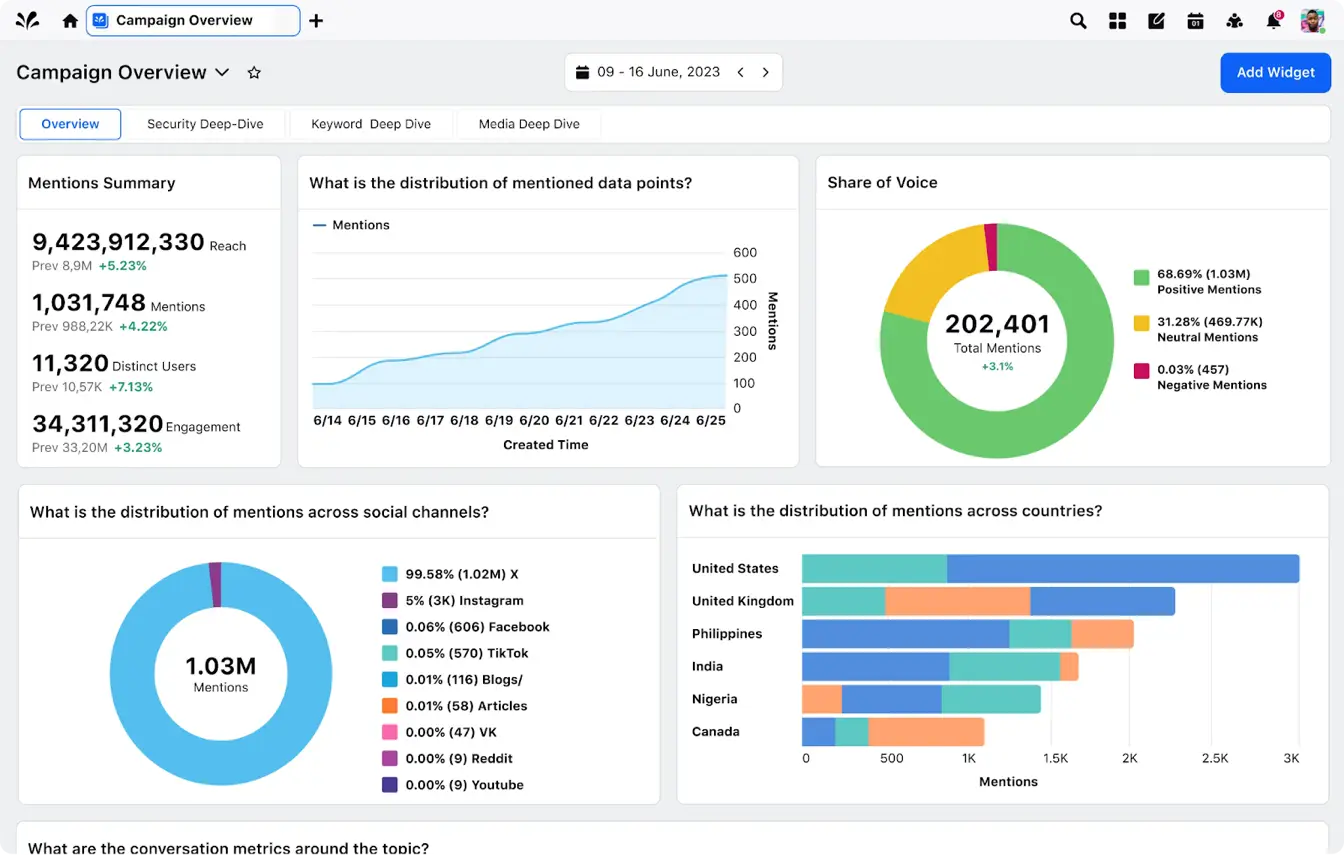
You can check the Sprinklr social listening dashboard below with its varied feature coverage. For more information, you also get access to a free demo!
What can you do with insights from social listening?
Social listening insights can be applied across multiple business functions, not just marketing. Based on what the conversation data reveals, brands typically use insights to fix product issues, expand features or availability, build or adjust campaigns, improve search or product quality, and engineer cultural moments.
The insight itself is only the starting point — the value comes from routing it to the right team, at the right time, with the right context to act on it.
Final Summary
Social listening isn’t just about tracking online chatter — it’s about turning those conversations into real business wins. From uncovering customer needs to preventing PR disasters, the examples we discussed above prove how powerful listening can be when it’s done right.
By diving into what your customers are saying, you can improve your brand’s reputation, create products your customers actually want, and stay ahead of market trends. For you, this means smarter decisions, stronger connections with your audience, and real ROI.
If you want to see social listening in action, our advanced social listening tool can monitor every relevant conversation, respond at scale, and turn insights into measurable results.
Frequently Asked Questions
Top social listening examples show how brands use customer conversations to solve real business problems, such as:
- Analyzing consumer conversations
- Competitor mention monitoring
- Brand reputation monitoring
- Emerging trends detection
- Product-related discussions
By monitoring social media conversations, brands can proactively identify and address potential PR crises before they escalate. Social listening tools can help detect negative sentiment, track emerging issues, and identify potential brand reputation risks.
Social listening can provide valuable insights into customer needs, preferences, and pain points. By analyzing customer feedback, brands can identify areas of improvement and ensure that their products meet the evolving market needs.

