

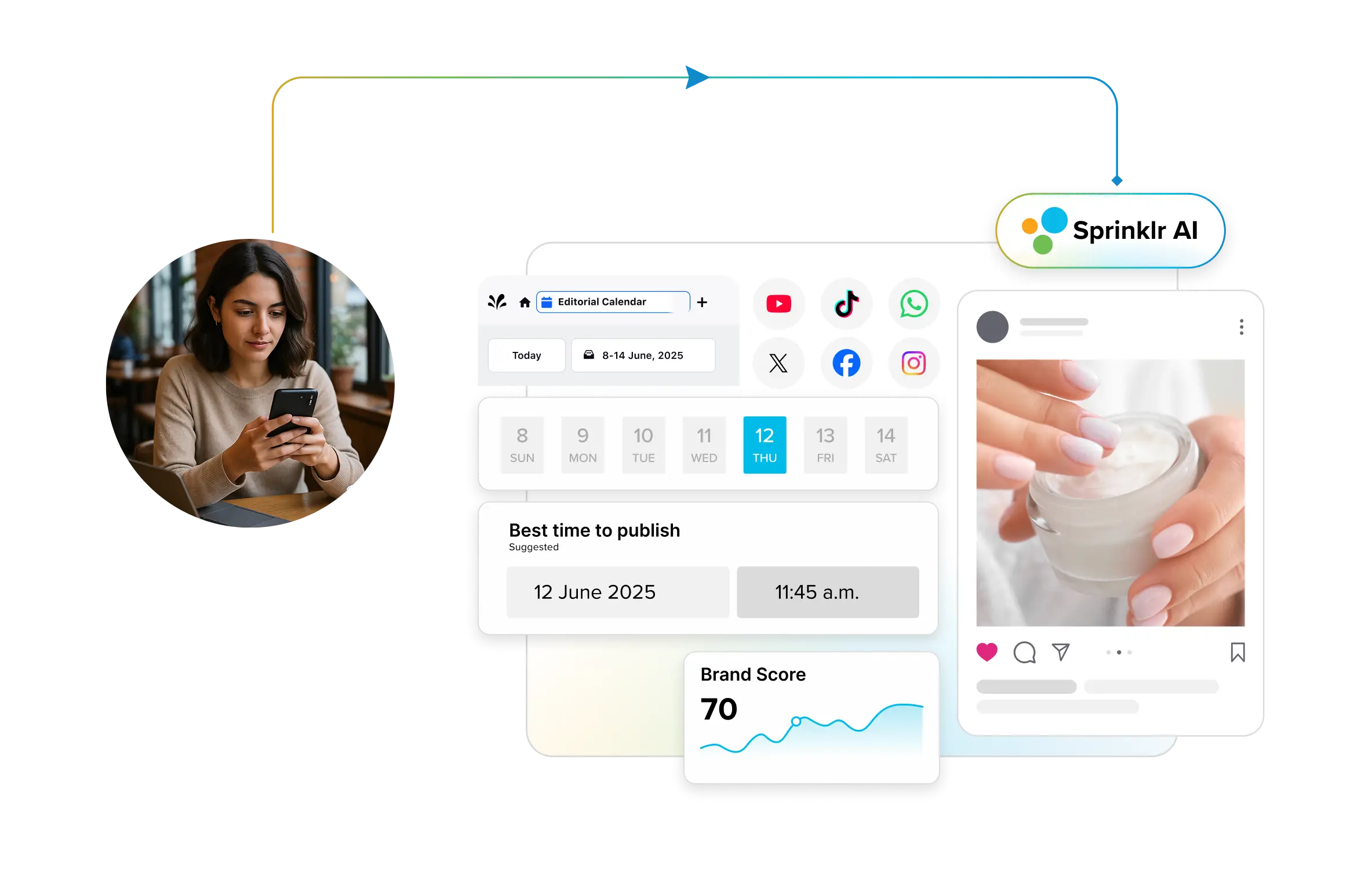
The global leader in enterprise social media management
For over a decade, Sprinklr Social has helped the world’s biggest brands reimagine social media as a growth driver with a unified platform, industry-leading AI and enterprise-grade scale.

25 Key Social Media Marketing Statistics for 2026
Aishwarya Suresh is an experienced content writer specializing in social media management, social listening, social analytics, Voice of the Customer (VoC) and customer experience. She writes practical, research-backed guides that help brands understand customer conversations, measure social media performance and turn insights into meaningful business decisions.
Key Takeaways:
- 5.79 billion people are on social and daily time spent has held near 2 hours 21 minutes for two years. Audience growth no longer means attention growth.
- Global social ad spend reaches $338.75 billion in 2026, with mobile set to carry 82.9% of it by 2030. Cost per impression is rising faster than returns on most platforms.
- Social commerce crosses $100 billion in the US for the first time, and influencer marketing is now a $32.55 billion industry. Both are revenue lines, not experiments.
- Engagement is declining almost everywhere while brands publish more than ever. Replying to your audience lifts performance more reliably than adding to your posting calendar.
- 87% of marketers use generative AI, and 46% of buyers now start research on an AI platform. Visibility inside those answers is the metric most social teams are not tracking yet.
Social media marketing statistics are the benchmark numbers that show how people use social platforms, how much brands spend there, and what that spend returns. For 2026, the three headline figures are 5.79 billion social media user identities worldwide, $338.75 billion in global social ad spend, and an average of 2 hours 40 minutes of daily use.
Those numbers must have been quoted in a hundred decks this year. None of them will tell you which channel to cut, which format to double down on, or why your engagement rate fell while your output went up.
That is what the rest of this page is for. Every click, like and share is feedback. Read it correctly and it shows you where budget earns its keep, how fast customers expect a reply, and where a competitor is quietly taking share.
The 25 statistics below are grouped the way a planning conversation actually runs: audience behavior, platform performance, ad spend, commerce and creators, listening and AI visibility, and business outcomes.
- 1. Shifts in social media engagement and user behavior
- 2. Top social media platforms by growth, reach and activity
- 3. Social advertising scale & spend
- 4. Social commerce and creator marketing ROI
- 5. Social listening, crisis detection and AI visibility
- 6. AI adoption and the productivity picture
- 7. Social media impact on business outcomes
- Turning insights into impact: Your next step with Sprinklr Social
1. Shifts in social media engagement and user behavior
More people are on social than ever. The hours they spend there have stopped growing. That single fact shapes almost every planning decision below.
1. As of April 2026, 5.79 billion social media user identities are active worldwide, equal to 69.9% of the global population and 94.7% of all internet users. The typical user is active on 6.5 platforms each month.
Worth flagging for anyone reconciling numbers: these are identities. Duplicate and dormant accounts inflate every platform-reported total, which is why your audience figures and your reach figures will never line up exactly.
2. Global daily time on social media is 2 hours 40 minutes. Measured across the broader social-plus-video window, GWI puts weekly engagement at 18 hours 36 minutes.
The daily time budget is structurally full. Any minute you win now comes out of another app.
3. 49% of US consumers have used TikTok as a search engine, up from 41% in 2024. Out of platforms they find most helpful for search, Google is ranked first at 85%, followed by Reddit at 29%, ChatGPT at 26%, YouTube at 24% and TikTok at 16%.
4. 46% of AI users now begin purchase research on a standalone AI platform such as ChatGPT, Gemini, Perplexity or Claude, up from 25% in 2024. Traditional search fell from 43% to 24% over the same period.
Discovery has moved into places most social teams do not report on yet. Your social content, reviews and community threads all feed what those assistants say back, so visibility in AI answers is now part of the social remit too.
5. Engagement rates are declining on most platforms, though TikTok continues to outperform at 4.9%. Accounts that consistently respond to comments see up to 42% higher engagement on Threads and 30% higher on LinkedIn, which makes replying the most underused lever available to most brands.
6. Reddit reached 130.3 million daily active users in Q2 2026 and is now the most-cited source across AI-generated answers at roughly 40% of all LLM citations, around three times Wikipedia.
Reddit has quietly become the research layer between discovery and purchase. If your category has active subreddits, that conversation is shaping both search results and AI answers whether or not you participate in it.
What this means for you:
→ Plan for a fixed attention budget. With time spent flat and users spread across 6.5 platforms, fewer and sharper posts will outperform higher volume.
→ Treat search as three channels now: social search, traditional search and AI assistants. Audit how your brand shows up in all three, not just the one you rank for.
→ Rebase your engagement benchmarks. A flat engagement rate in 2026 is a relative gain, so report trend against platform averages rather than against your own last year.
→ Watch Reddit and community forums like a listening channel, not a posting channel. That is where purchase intent is validated.
2. Top social media platforms by growth, reach and activity
Platform performance in 2026 splits into clear lanes. Knowing where each channel actually wins matters most when you are defending budget line by line.
7. Advertising reach across the major platforms: YouTube 2.65 billion, Facebook 2.39 billion, TikTok 2.21 billion, and Instagram 1.99 billion. LinkedIn reports 1.43 billion, though that figure counts registered members rather than monthly actives and is not directly comparable.
8. Short-form video is now the default surface. YouTube Shorts averages 200 billion daily views, and Instagram Reels crossed a $50 billion annual run rate. More than half of all Instagram ads ran on Reels in 2025, up from 35% the year before.
9. LinkedIn remains one of the strongest-performing platforms for B2B engagement and thought leadership, and document carousels are its best-performing format at a 7.00% average engagement rate.
10. Threads reached 500 million monthly active users in June 2026 and passed X in mobile daily active users in January 2026. Its median engagement rate sits at 6.25% against 3.6% for X.
Threads has scale now, and responsive accounts see some of the strongest engagement lifts on any platform. Worth a properly resourced test if your audience is already there.
What this means for you:
→ Meta still delivers the most efficient reach at scale, but the buy has moved. Plan Reels-first creative rather than adapting feed assets.
→ Shorts is no longer a secondary placement. At 200 billion daily views it deserves its own production line, not repurposed TikTok exports with a watermark.
→ For B2B, carousels and native video on LinkedIn are the highest-yield formats available anywhere. If your LinkedIn plan is text-first, that is the fastest fix on this list.
→ Give Threads a real test with real resourcing. Engagement
Read More: Social Media Content Strategy for Each Platform
How often should brands post on each social platform in 2026?
As a working baseline: Instagram 1 to 2 posts a day, Facebook around once a day, LinkedIn 3 to 5 times a week, X 2 to 5 times a day and TikTok 1 to 4 times a day. On Instagram, many teams do better at 3 to 5 posts a week with a mix of carousels, Reels, static posts and Stories. The more useful finding sits underneath those ranges. Posting more does not reliably lift engagement. Sprinklr Social Index data shows retail brands publishing 60 or more posts a week grow followers 45% slower, while CPG brands posting four times a week outperform peers posting six. Set cadence from what your team can sustain at quality, then test upward and watch follower growth alongside engagement.
3. Social advertising scale & spend
Budgets are still growing, and so is the cost of every impression inside them. The 2026 data shows where advertisers are getting more back than they put in.
11. Global social media ad spend is projected to reach $338.75 billion in 2026, growing at an 11.86% CAGR to $530.34 billion by 2030. The United States alone accounts for roughly $126 billion of the 2026 total.
12. Mobile is set to carry 82.9% of all social ad spend by 2030. Almost everything you run will be watched on a phone, often with the sound off, which makes vertical video and readable on-screen text a production standard.
13. On Instagram, format now decides outcome. Carousels generate nine times more saves than single-image posts, while Reels drive more than four times the interactions of single images and average watch time has doubled year over year to 8.5 seconds. Single-image posts are falling away, with reach down 21.96% and engagement down 45.98%.
Reels bring people in. Carousels give them a reason to keep the post. Most social media content calendars still treat them as interchangeable.
What this means for you:
→ Attention will cost more in 2026 than it did in 2025. Build the CPM increase into planning assumptions instead of treating it as underperformance.
→ Make sound optional. Captions, on-screen text and a clear first frame do more for performance than production polish.
→ Split your Instagram objectives by format. Reels for reach targets, carousels for consideration and engagement targets.
→ Rebalance toward the platforms where a dollar still buys disproportionate attention rather than spreading spend evenly for coverage.
Also Read: Organic vs Paid Social Media: Choose the Right Channel
Are social media engagement rates falling on every platform, and does that mean my strategy is broken?
Engagement rates are declining across most platforms in 2026, with TikTok still leading benchmarks at 4.9%. Feeds are more crowded, brands are publishing more than ever, and audiences respond to relevance, timing, and responsiveness rather than volume alone. A falling rate on its own is not a strategy failure. What matters more is whether you are showing up in conversations. Brands that consistently reply to comments see up to 42% higher engagement on Threads and 30% higher on LinkedIn, which suggests the gap is often responsiveness rather than content quality. Benchmark by platform, format and industry, then look at your reply rate before you rebuild your content plan.
4. Social commerce and creator marketing ROI
Social commerce crossed a psychological threshold in 2026, and creator budgets moved with it. Both are now line items with revenue attached rather than experiments looking for proof.
14. US social commerce sales cross $100 billion for the first time in 2026, up roughly 18% year over year and equal to about 7.2% of total US ecommerce.
15. Globally, social commerce accounts for roughly 15% of total ecommerce in 2026, with China alone generating an estimated $366 billion in social commerce revenue.
16. TikTok Shop US GMV is projected at $23.4 billion in 2026, up from $15.1 billion in 2025 and $9 billion in 2024. It remains the one social commerce figure multiple independent sources corroborate.
A caution worth carrying: Meta does not disclose Instagram GMV, and third-party estimates for the same metric range from $8.7 billion to $37.7 billion. Quote TikTok Shop with confidence and treat Instagram commerce numbers as directional.
17. Influencer marketing is a $32.55 billion global industry, and 87.49% of marketers expect their influencer budgets to increase in 2026, with 72.22% expecting a rise of 50% or more. Rising creator costs are the single most cited challenge at 35.4%.
18. On Instagram specifically, the creator tier mix is shifting down-market. Micro-influencers (10K to 100K followers) average 3.86% engagement against 1.21% for mega creators, and 66.33% of brands now run influencer programs entirely in-house.
Engagement tiers vary by platform, so treat that gap as an Instagram benchmark rather than a universal rule.
What this means for you:
→ Social is a place people buy now, not just a place they click through from. Plan your product drops and offers there the way you would plan them on site.
→ A budget increase of 50% or more will break an informal creator program. Fix discovery, contracting and measurement before the money lands, not after.
→ Relevance is beating reach on creator selection. A roster of micro creators in-category will usually outperform one macro name across engagement and cost.
→ If you are bringing influencer work in-house alongside two thirds of the market, make sure paid, organic and creator performance sit in one view. Separate dashboards will hide double-counted results.
Learn More: AI in Influencer Marketing: Real Use Cases & What’s Next
5. Social listening, crisis detection and AI visibility
Social listening has widened past brand sentiment. In 2026, it also covers how your brand is described inside AI-generated answers, which is the newest place customers form an opinion before they ever reach you.
19. 45% of U.S. consumers used AI tools to get local business recommendations in 2026, up from just 6% the previous year, with ChatGPT the most widely used tool.
20. AI platforms are far more selective than search engines. Brand locations appeared in AI-generated recommendations just 6.5% of the time, against 36% in Google's local 3-pack, and Gemini recommended brands in only 11% of cases.
Ranking well and being recommended are now two different outcomes. A brand can hold page-one positions and still be absent from the answer a customer actually reads.
21. Trust has not kept pace with adoption. Gen Z trusts work completed without AI at 69%, against 28% for AI-assisted work and just 3% for fully AI-generated work, with 97% of companies now reviewing or editing AI-generated content before it ships. Across 19 markets, consumer trust in AI assistants sits at 28% in U.S.
What this means for you:
→ Add AI answer visibility to your listening scope. If you cannot see which prompts return your brand, you cannot fix the gaps.
→ Audit the third-party sources AI systems lean on in your category, particularly Reddit, review sites and community forums. Most citations come from places you do not own.
→ Keep a human review step on anything published. The efficiency case for AI is settled, the trust case is not, and Gen Z is already policing the difference.
→ Route listening alerts to the teams who can act on them. Detection speed only matters if it reaches someone with the authority to respond.
💡 Pro Tip: Social listening was never really about counting mentions. The advantage comes from understanding why people are talking, the context behind a sentiment shift, and where a conversation is heading before it lands on your feed.
Sprinklr Insights is built for that wider job. It listens across 30+ social and digital channels in real time, uses AI Topics to filter noise down to brand-relevant conversation, and extends analysis beyond text and images into video through ViralMoment, so cultural signals in short-form content do not get missed. Its LLM Insights capability shows which prompts and topics return your brand in AI-generated answers, which is how AEO and GEO performance becomes something you can actually measure and improve. Sprinklr was named a Leader in the 2026 Gartner® Magic Quadrant™ for Social Media Management and Listening.
6. AI adoption and the productivity picture
Almost every marketing team is using AI now. The question worth asking in 2026 is what that adoption is actually returning.
22. 87% of marketers use generative AI in at least one workflow, up from 51% in 2024. Among social marketers specifically, 89.7% use AI at least weekly, and 64.1% use it daily.
23. Marketers using AI agents reclaim around 8 hours a week and report a 20% lift in marketing ROI.
Eight hours is a full working day returned to every person on the team. The teams pulling ahead are the ones spending it on social strategy and testing rather than absorbing it into more output.
What this means for you:
→ Near-universal adoption means AI is no longer the advantage. How you govern and deploy it is.
→ Measure the reclaimed hours. If the time saved is not showing up as better testing, faster response or stronger creative, the efficiency gain is invisible to the business.
7. Social media impact on business outcomes
24. What others say about a brand carries more weight than what the brand says about itself. Consumers place the greatest trust in unpaid advocates, customers and peers, and are almost 2x more willing to support a brand that has earned both trust and relevance. User-generated content earns roughly 6.9 times more engagement than brand-created content, and 92% of consumers say they trust peer recommendations over brand messaging.
25. 67% of customers find contacting support on social convenient, 89% expect a reply to a complaint within 60 minutes, and 72% say they are more loyal to brands that respond quickly on social. Yet only 36% of brands reply within an hour.
That gap between what customers expect and what most brands deliver is the clearest opportunity in this dataset.
What this means for you:
→ Build a real UGC pipeline with rights management attached. Authentic customer content is both the highest-performing format and the cheapest to produce.
→ Close the service gap before you chase another format. Fast, personal responses on social are a priority customers have stated explicitly, and most competitors are underweighting.
→ Use AI for speed rather than for substitution. Customers are comfortable with AI-assisted care, and noticeably less comfortable with AI-generated personality.
→ Report social against pipeline, retention and share of voice. Engagement alone will not survive a budget conversation in 2026.
Turning insights into impact: Your next step with Sprinklr Social
These 25 statistics point to the same conclusion from five directions. Attention is finite, discovery has fragmented across social, search and AI, formats decide performance more than platforms do, and the brands winning are the ones acting on live signals rather than last quarter's report.
Sprinklr Social is built for that reality. It unifies publishing, engagement, listening, advertising, commerce and advocacy across 30+ social and messaging channels on one platform, with AI trained on billions of interactions and enterprise governance that holds up across brands, markets and business units. For example, our customers, Santander UK used it to reach over 100 million people and drive more than 1.5 million engagements in a year, Shell runs 100+ accounts from a single platform, Stage Entertainment saved $65,000 and over 2,000 hours by reusing 58% of its social content, Uber cut first response time by 33%.
Ready to outperform like them? Request a demo to see how leading brands turn these trends into results.
Frequently Asked Questions
Short-form video became the default surface, with YouTube Shorts at 200 billion daily views and Reels carrying more than half of all Instagram ads. Social search matured, with 49% of US consumers using TikTok as a search engine. AI-assisted content became near-universal at 87% adoption while consumer tolerance for obviously synthetic content fell. Creator budgets scaled sharply, with 87% of marketers planning increases. And community platforms like Reddit and Threads moved from niche to mainstream planning consideration.
It depends on how you measure. By advertising reach, YouTube leads at 2.65 billion, ahead of Facebook at 2.39 billion, TikTok at 2.21 billion and Instagram at 1.99 billion. By survey, 56.3% of adult internet users said they had used Facebook in the past month, narrowly ahead of YouTube at 55.3%, Instagram at 54.6% and WhatsApp at 54.4%. In the US, 84% of adults use YouTube and 71% use Facebook, the only two platforms a majority of every age group uses.
UGC generates roughly 6.9 times more engagement than brand-created content, and 92% of consumers trust peer recommendations over brand messaging. Around 84% say they are more likely to trust a brand that features real customer content. Its strength is concentrated at the decision stage, where reviews, customer photos and creator content resolve the doubt a brand asset cannot.
ROI follows objective rather than platform. Meta still delivers the most efficient reach at scale given 2.39 billion in advertising reach. TikTok Shop is the strongest performer for direct commerce, with US GMV projected at $23.4 billion in 2026. LinkedIn remains the strongest platform for B2B pipeline and thought leadership, where document carousels and native video consistently outperform text-only posts. Reddit is worth testing for consideration-stage reach, with roughly 40% of conversations on the platform carrying commercial intent and one in three users researching purchases there.
87% of marketers now use generative AI in at least one workflow, and 89.7% of social marketers use it at least weekly. Teams running AI agents reclaim around 8 hours a week and report a 20% lift in marketing ROI. The constraint is trust rather than capability: 97% of companies review or edit AI-generated content before publishing, and half of Gen Z have unfollowed accounts they believed were AI-generated.
Because listening now covers three jobs instead of one. It protects reputation through early crisis detection, it feeds product and CX decisions with real customer language, and it shows how your brand is represented inside AI-generated answers, where 45% of U.S. consumers now go for recommendations. With AI platforms recommending brands in only a small fraction of relevant queries, visibility in those answers has become something you have to monitor deliberately rather than assume.
Yes, and the money reflects it. Influencer marketing is a $32.55 billion global industry, 87.49% of marketers expect budgets to rise in 2026 and 72.22% expect an increase of 50% or more. The shape of the spend is changing though. Micro-influencers average 3.86% engagement against 1.21% for mega creators, 66.33% of brands now run programs entirely in-house, and rising creator costs are the most cited challenge in the category.
Aishwarya Suresh is an experienced content writer specializing in social media management, social listening, social analytics, Voice of the Customer (VoC) and customer experience. She writes practical, research-backed guides that help brands understand customer conversations, measure social media performance and turn insights into meaningful business decisions.
Explore Social Media Marketing